

Executive Summary
India's e-commerce market is among the fastest-growing in the world — and its logistics infrastructure is evolving at pace to serve it. Yet beneath the headline growth numbers lies an operational complexity that is specific to the Indian market and poorly served by logistics technology platforms designed for Western e-commerce environments.
This white paper examines three dimensions of that complexity:
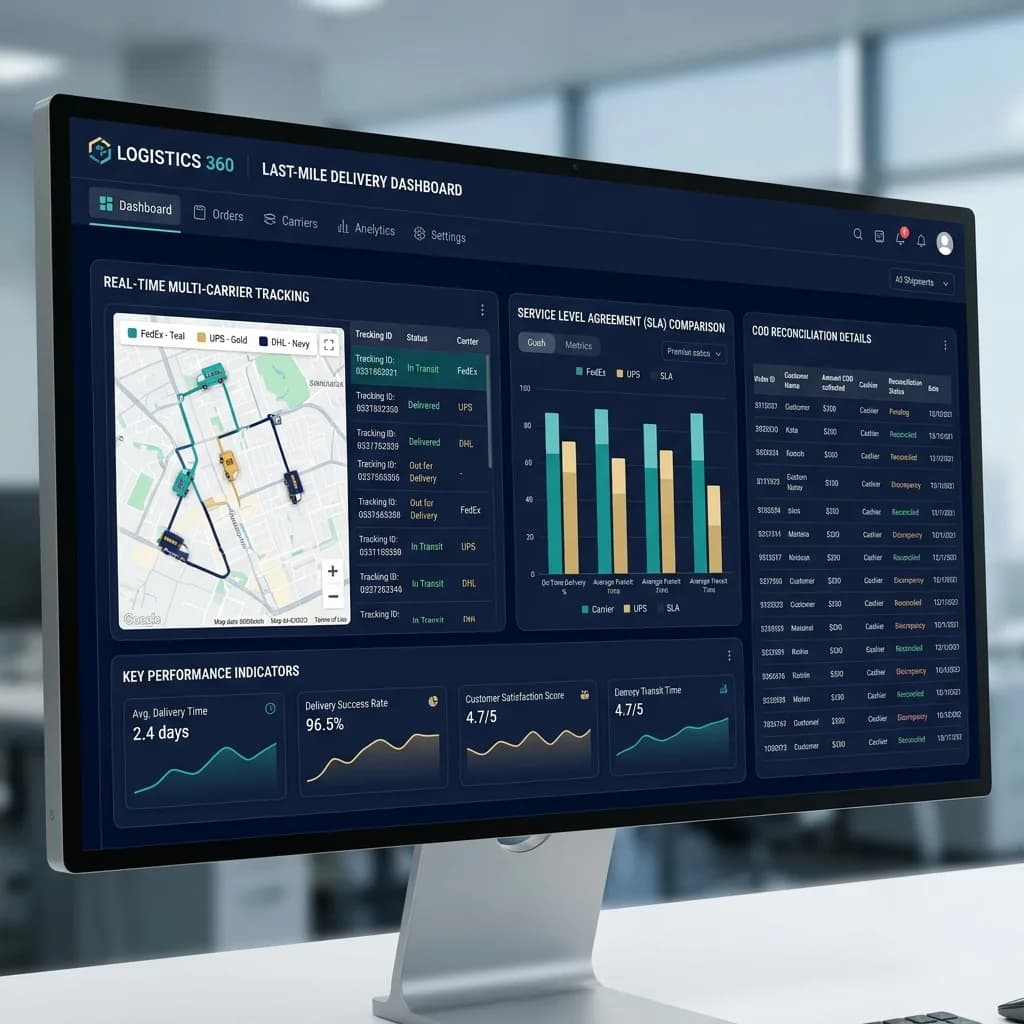
The Multi-Carrier Imperative: India's courier landscape is fragmented by geography, service quality, and cost structure in ways that make single-carrier strategies commercially and operationally suboptimal. No carrier covers all of India's 19,000+ serviceable pin codes with equal efficiency. The case for systematic multi-carrier management is not a technology preference — it is an operational and financial necessity for any e-commerce business shipping at scale.
The COD Challenge: Cash-on-delivery remains a dominant payment method in Indian e-commerce — representing 40 to 60% of order value in many categories and geographies. COD creates a financial management challenge that Western logistics platforms were not designed to handle: the logistics provider collects payment on behalf of the merchant and remits after a settlement cycle. Managing COD accurately at scale, across multiple carriers with different settlement frequencies and formats, is one of the most underappreciated operational challenges in Indian e-commerce logistics.
The Technology Gap: The majority of Indian logistics businesses — from D2C brands managing their own fulfillment to 3PL providers managing logistics for multiple clients — are operating below the technology adoption threshold at which logistics automation delivers measurable returns. The gap is not primarily a cost or awareness problem. It is an integration complexity problem: connecting order management, warehouse operations, carrier APIs, and accounting systems into a coherent operational flow requires technology infrastructure that most businesses have not yet assembled.
1. India's E-commerce Logistics Landscape
1.1 Scale and Growth India's e-commerce market has grown from a niche segment to a significant share of retail consumption over the past decade. The combination of smartphone penetration, UPI payment infrastructure, improving rural internet connectivity, and a young, digitally native consumer base has driven e-commerce growth into Tier 2, Tier 3, and semi-urban geographies that were previously considered outside the e-commerce addressable market.
This geographic expansion has fundamentally changed the logistics challenge. Early Indian e-commerce was concentrated in the top 8 to 10 metro cities — geographies well-served by existing courier infrastructure with standardised delivery economics. The current growth vector is into the next 500 cities and towns — geographies with highly variable courier coverage, significantly higher delivery failure rates, and different operational requirements for successful delivery execution.
1.2 The Structural Complexity of Indian Logistics Several structural characteristics of Indian logistics create complexity that is specific to this market:
*Geographic diversity:* India's deliverable geography spans dense urban centres where 30-minute delivery is commercially viable, to semi-urban areas where next-day delivery is aspirational, to remote locations where weekly deliveries are the realistic expectation. A logistics strategy that works for Pune may not work for rural Maharashtra, and certainly does not transfer to Assam without modification.
*Payment mode fragmentation:* Despite the rapid growth of UPI and digital payment adoption, cash-on-delivery remains a primary payment mode in many categories — particularly in Tier 2 and Tier 3 geographies and in product categories (fashion, electronics, home goods) with high return rates. The operational and financial management of COD adds a layer of complexity absent from logistics in most other major e-commerce markets.
*Returns complexity:* India's e-commerce return rates — driven by size and fit issues in apparel, quality expectation mismatches, and impulse purchase reversal — create a significant reverse logistics flow that most carriers manage separately from forward logistics. Managing returns efficiently, at reasonable cost, is a persistent operational challenge for e-commerce businesses.
*Carrier market structure:* Unlike the US and European markets where two or three major carriers serve the vast majority of e-commerce logistics volume, India's carrier market is fragmented across dozens of providers with overlapping but not identical coverage, service quality profiles that vary significantly by geography, and pricing structures that fluctuate based on capacity and demand.
2. The Indian Carrier Ecosystem
2.1 The Major Players and Their Operational Profiles India's e-commerce logistics carrier market is served by a combination of large national networks, specialised e-commerce carriers, and regional providers. The leading national players have each evolved distinct operational profiles:
*Delhivery* has built India's largest integrated logistics network — covering over 18,000 serviceable pin codes for express delivery and a significantly larger geography for surface freight. Delhivery's scale provides pricing leverage for high-volume shippers and geographic coverage that no single competitor matches.
*Bluedart* (DHL Express India) is positioned as India's premium express courier — with strong SLA commitments in metro and Tier 1 city deliveries and a reputation for higher delivery success rates in urban geographies.
*Ecom Express* was purpose-built for e-commerce logistics from its inception — with infrastructure designed around the operational requirements of high-volume e-commerce fulfillment rather than adapted from a general parcel delivery model.
*DTDC* is one of India's oldest courier networks — built over decades through a franchise model that has created extensive Tier 2 and Tier 3 coverage.
*Shadowfax* has built a technology-first hyperlocal and same-day delivery model — with particular strength in metro and Tier 1 cities for time-sensitive delivery.
*Xpressbees* is a growing national e-commerce carrier with competitive standard delivery pricing and expanding network reach.
2.2 The Case Against Single-Carrier Dependence The performance profile of each carrier varies — by geography, by product category, by time of year, and by the carrier's current capacity utilisation. No carrier provides uniformly optimal cost, delivery success rate, and transit time across all of India's serviceable geographies.
Analysis of delivery performance data across Indian e-commerce logistics shows consistent patterns: *Delivery success rate variation by carrier and geography:* For non-metro PIN codes, delivery success rates vary by 15 to 25 percentage points between the best-performing and worst-performing carrier. *Cost variation by weight band and destination:* Per-shipment cost varies significantly across carriers for the same origin-destination pair and weight — often by 20 to 40%. *Transit time variation:* For standard delivery, actual transit times vary by carrier and by geographic lane — independent of stated SLAs.
These variations mean that a single-carrier strategy is systematically leaving either money or service quality on the table.
3. Multi-Carrier Management — The Case for Systematic Optimisation
3.1 The Carrier Selection Decision — What It Should Be Based On Effective multi-carrier management requires making carrier selection decisions based on data rather than familiarity or habit. The carrier selection decision for each shipment should consider:
*Destination serviceability:* Is the carrier reliably servicing the destination PIN code? *Historical delivery success rate:* For a given PIN code cluster, what has the carrier's actual delivery success rate been over the past 90 days? *Current cost:* Live rate comparison at the time of booking reflects current carrier pricing, including promotional rates. *Delivery timeline:* For time-sensitive orders, the carrier's actual transit time performance for the relevant geographic lane is the relevant criterion. *COD track record:* For COD shipments, the carrier's COD collection success rate and remittance timeline are direct financial factors in the decision.
3.2 The Economics of Systematic Carrier Optimisation The financial benefit of systematic carrier optimisation manifests in three ways:
*Shipping cost reduction:* By selecting the lowest-cost carrier that meets the delivery requirements for each shipment, businesses typically reduce average shipping cost per order by 12 to 22%.
*RTO cost reduction:* Return-to-origin (RTO) occurs when a delivery fails and the shipment returns to the sender. Routing shipments to higher-performing carriers for high-RTO-risk geographies reduces RTO rates by 1 to 3 percentage points.
*COD write-off reduction:* Routing COD shipments to carriers with higher delivery success rates reduces the frequency of delivery failure and lost sales.
4. COD Economics — Managing India's Dominant Payment Method
4.1 The Scale of COD in Indian E-commerce COD's persistence as a dominant payment mode in Indian e-commerce is often cited as a transitional phenomenon. While UPI adoption has grown dramatically, COD continues to represent a substantial share of e-commerce order value — particularly in Tier 2 and Tier 3 geographies, in categories with high return rates, and for first-time buyers. For many Indian e-commerce businesses, COD represents 40 to 60% of order value.
4.2 The COD Financial Management Challenge COD creates a unique financial management challenge: the carrier collects payment on behalf of the merchant at the time of delivery and remits after a settlement cycle. This creates:
*A float period:* During the settlement cycle, the merchant has shipped the product but has not received the payment. *Remittance reconciliation complexity:* Each carrier remits COD in their own format. Matching remittance amounts against the expected COD for each shipment is a labour-intensive process when done manually. *COD fraud exposure:* COD delivery fraud — false delivery confirmation claims, partial collection, or mismatch between collected and remitted amounts — is a real operational risk without systematic reconciliation at the shipment level.
4.3 Technology Solutions for COD Management Effective COD management at scale requires technology infrastructure that tracks expected COD amounts at the shipment level and matches remittances against those amounts automatically.
5. The Last-Mile Challenge in Tier 2, Tier 3, and Rural India
5.1 Why Non-Metro Delivery Is Fundamentally Different Last-mile delivery in Indian metro areas operates under broadly similar conditions to urban delivery in other major e-commerce markets. Non-metro delivery operates under fundamentally different conditions:
*Address quality and geocoding:* Indian addresses in non-metro geographies frequently lack structure. Delivery agents rely on local knowledge and phone calls to recipients. *Recipient availability:* The proportion of households without a consistently available adult to receive deliveries during working hours is higher. *COD preference concentration:* COD adoption is higher in non-metro geographies. *Carrier infrastructure variation:* The infrastructure depth of major carriers varies significantly between carriers for non-metro geographies.
5.2 Implications for Carrier Selection Strategy The last-mile delivery characteristics of non-metro India have direct implications for carrier selection strategy: Performance-based routing for non-metro PIN codes is more valuable than cost-based routing. A cheaper carrier that fails to deliver is more expensive than a reliable carrier. Carrier performance data by PIN code cluster is more relevant than aggregate carrier performance data.
6. Technology Adoption in Indian Logistics
6.1 The Integration Gap The primary barrier to technology adoption in Indian e-commerce logistics is not cost or awareness — it is the complexity of integration between the systems that constitute a complete logistics technology stack: Order management, Warehouse management, Carrier connectivity, Tracking, COD management, and Accounting.
Connecting these systems into a coherent operational flow requires API development across multiple parties. The resource requirement for building and maintaining this integration is beyond the capacity of most Indian e-commerce businesses without dedicated technical teams.
6.2 Courier Aggregator Platforms as Integration Infrastructure Courier aggregator platforms address the integration gap by providing a single API layer that connects to multiple carriers. The value proposition is not primarily rate comparison. It is the reduction of integration complexity that allows businesses to operate multi-carrier logistics without dedicated integration engineering resources.